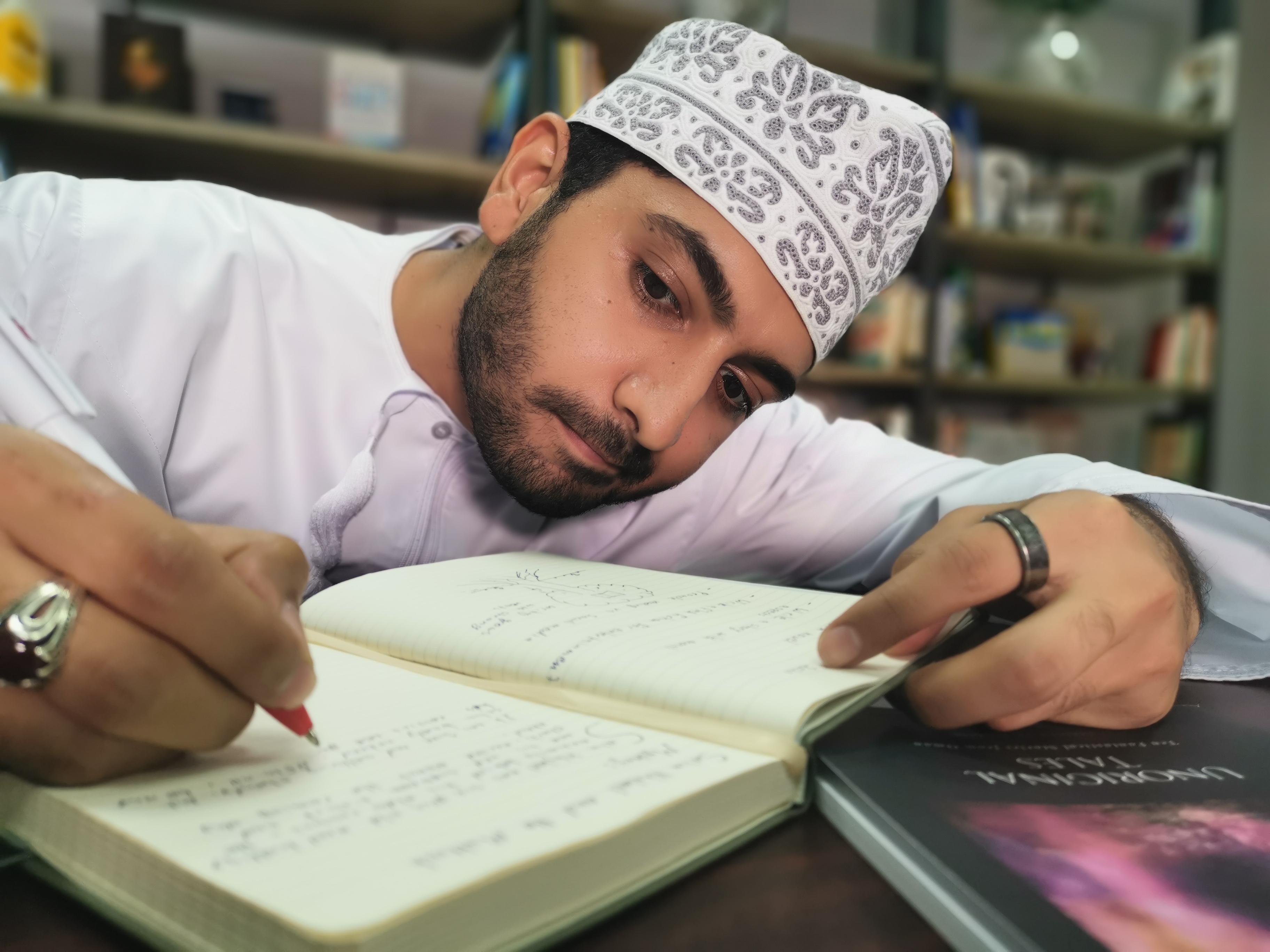
By: Ammar Al Naaimi
Date: Jan, 2022

Great, you’ve written a book in Oman! Really, well done. I’m guessing you’re either an employee or a student, neither option of which gives you enough time to write. The fact that you’ve gotten this far deserves applause.
So now, what’s the next step? How do you go from a word document on your laptop to a local bestseller?
My name is Ammar Al Naaimi, Author of Sarim, which is a fun adventure novel about exorcists in Muscat, 2019. After going through my own process in publishing, I started getting a LOT of messages on Instagram about the novel publishing process in Oman. So, I decided to create this blog post to let you know a bit about it. Below is my 5-step guide to publishing books in Oman!
1- Editing
2- Formal Procedures with the Ministry of Information
3- Marketing
4- Printing/Publishing
5- Distribution
I look forward to seeing your book on the shelves.
Step 1- Editing

Editing is pain. It truly hurts my heart every time I do it. Why can’t I just bring out perfect books from the start? But guys, I want to stress that editing is a MUST. I don’t know of any person who has successfully published a first draft where it legitimately became successful. There are all types of editing tricks, as well as resources to hire editors for cheap, such as fiverr, etc. But that’s not the point of this blog post, so I suggest you read more about editing in general.
For Sarim, I did 3 drafts on my own, then hired a structural editor. I then did 2 drafts, and finally hired a proofread. The grand total stood at 6-7 drafts. But that’s just me. Maybe your book (an Omani mystery novel, maybe??) will go straight to an external editor. Either way, do not neglect editing, please. An unedited book will just tell people that you don’t care about whether the story is any good or not.
Step 2- Formal Procedures
This is where things go different if you’re Omani. In Oman, you require a permit from the Ministry of Information to print your book. This is meant to ensure that you’re not infringing on any of Oman’s existing laws or our overarching code of ethics. Regardless of how you feel about it, this is how the system works. Printing without a permit (and corresponding bar code) puts you in three risks:
1- The printer/publisher refuses to work with you.
2- Libraries refuse to distribute your book
3- You get fined eventually
So, uh, let’s not do that, ok? The process is pretty simple. You can go to the Injaaz Platform or go to a Sanad Office and ask them to go to Injaaz on your behalf. The login requires either a phone SIM-Card with PKI activated, or your ID Card in addition to your ID Card passcode. You will need to fill out a form with your information, and to upload a PDF of your book. The process is free, and you’re given an International Serial Book Number (ISBN) along with the permit.
The approval process should take around 6 weeks or so. If it takes longer, I HIGHLY recommend you call the Directorate General of Publications and Artistic Works. Ask them what’s up. If they say you were rejected, ask why. Hopefully, there is a small change you can make to fix the issue. Let’s not give up on your book because they took offence to one word.
Step 3- Marketing
Oh my god, this topic deserves an e-book all on its own. Let me make this clear right from the start: Your book will not sell itself on its own. Selling books requires value-creation and smart market segments and shouting and cajoling and posters and content and all sorts of videos to sell a book, and nobody will do this for you here, even if you decide to go with a publishing house. Here is a separate list of tips on book marketing. You should know even this guide isn’t telling you everything. Go look at what other people are doing.
I like to express the value of marketing as follows: Imagine that your book has the power to bring true joy to 10 specific people in Oman. It will actually change their lives. Wouldn’t you want to do everything you can to find them?
For Sarim, I used a three-pronged marketing strategy: First was creating silly skit videos to draw people in, second was content marketing via short stories to get them interested in my brand of writing, and the third was very clear advertisements about the book. I suggest you create your own custom strategy after deciding who the book is for.
One last point: Make friends. These are people who will partner up with you occasionally to do things that will elevate your brand. For me, it’s The PaperCut Club headed by the always-talented Fatma Makki, Oman Book Lover’s Club on Facebook, Amira Bait Ishaq, my writing bud, Suika Art Cafe, the incredible artist Mohammed Al Attar.
Step 4- The Actual Publishing/printing
Now you’re actually ready to think about how to publish your book. The first thing I need you to know is that most publishers in Oman adopt a vanity-style system, where you pay them money so that they print the book for you. You can learn more about vanity vs. traditional publishing systems here. Here is a non-exhaustive list of book publishers I know of in Oman:
I suggest you at least call these places and see what they can offer you. However, I ultimately decided that their services are not right for me, and went for a self-publishing model. This meant that I commissioned my own cover art, formatting, proofreading, etc, and then went directly to a printing press to ask for printing costs.
Printing presses have wildly different costs, and they also charge you less per book the more units you print. I highly recommend you use the three-quotation system. Check prices from three different places for three different quantities of books. In my case, I ended up printing 1000 copies of Sarim (way more than I needed) for about 850 baizas per copy. Also, PLEASE ask for 3 free samples so you can adjust the font/formatting/paper quality.
Step 5- Distribution
You now have a printed book, you’ve started marketing, hopefully you even have a preorder set up.
So now the question is: Who is going to sell your book? Is it going to be you, setting up tables across the country? Probably not, I suppose.
Book distribution is, uh, a bit of a new business model here in Oman. I know of only two companies that do it, and their networks aren’t very expansive. I ended up signing with Family Bookshop LLC, which gets me access to Al Fair, as well as the Muscat Book Fair, and that’s basically it.
Distribution is extremely important, since those are the people selling your book. I suggest that you pay attention to your distributors. My strategy became a ‘talk to individual bookstores’ sort of thing. I literally just walk in or call, tell them about Sarim, and offer to give them 10 copies in exchange for a 50% cut. This has landed me agreements with some good Omani stores like:
3- Booklands.OM
4- Pages Muscat
5- Minerva.OM
6- Kushkool in Middle East College
If you don’t know where to start, start there. The list of stores will be different if your book is in Arabic, so try to do your homework.
Conclusion
Publishing a book is a whole process that takes a lot of time and energy. My guide here is only a first step based on my experiences, and I encourage you to read widely and check out all sorts of other guides.
I hope this helps you on your journey, and I look forward to seeing your book on the shelves. We can bring truly amazing books to Oman and the entire ME region.
Love,
Ammar